
Inner Critic Healing — What If You Invited It In for Tea?
- Leigh Wilder

- Mar 24
- 3 min read
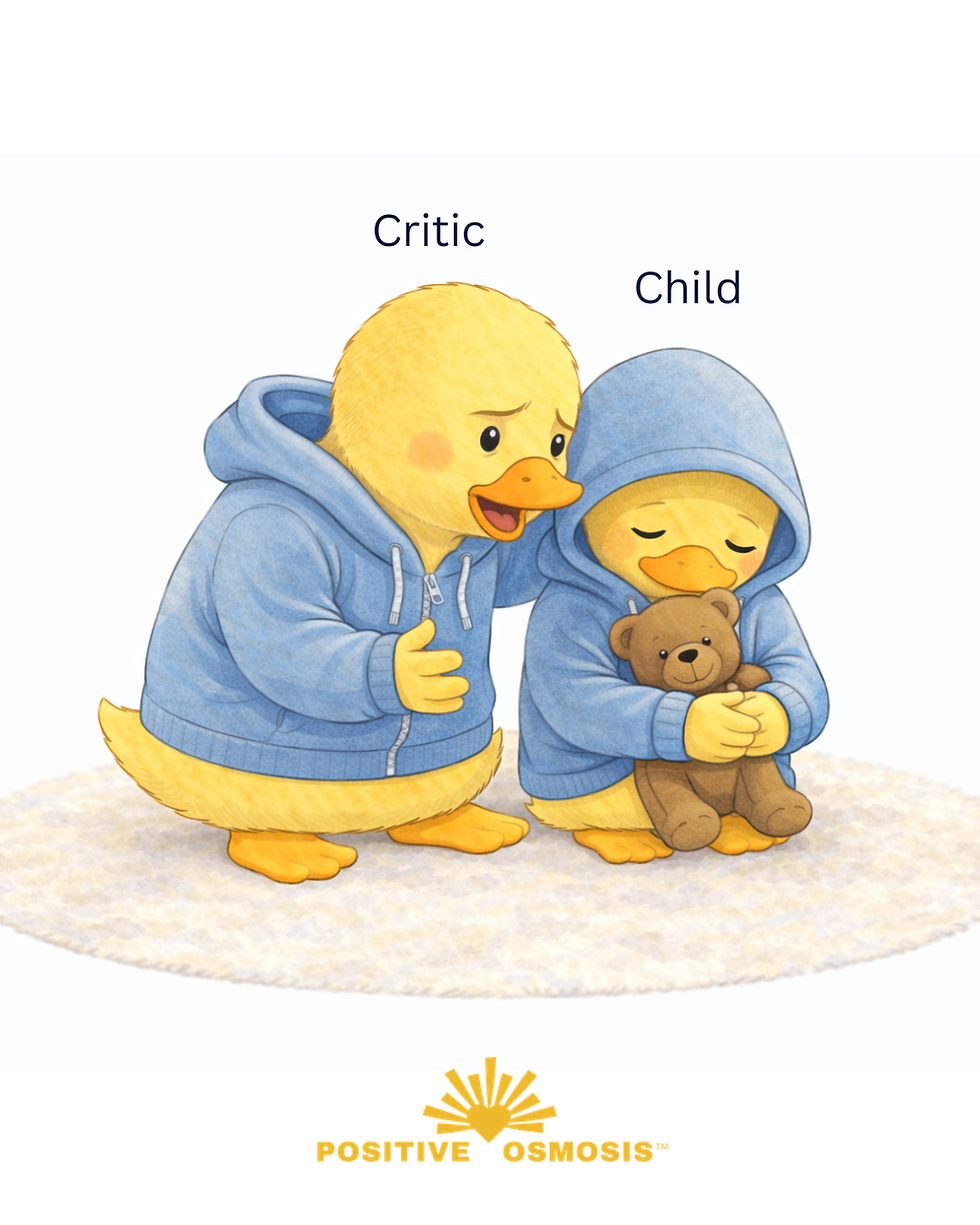
There's a teaching from Thich Nhat Hanh about welcoming your demons to the table — not fighting them, not running from them, but sitting with them gently and asking what they need.
For most of my life, I didn't want to invite my Critic anywhere near a table. I wanted it gone. Silenced. If there had been a surgery to remove it, I would have signed the consent forms without reading them.
It was the loudest voice in my head. The one that got there first. Before anyone else could tell me I wasn't enough, wasn't smart enough, wasn't worthy enough — my Critic said it first. Every time.
What I didn't understand then was that this was the whole point.
When we grow up without the protection we needed — when our caretakers couldn't or didn't show up the way we needed them to — something inside us steps in. A part of us decides: I will protect her. I will point out every flaw before the world can use them against her. I will keep her small and safe.
That part is the Critic.
Inner critic healing begins not with silence but with curiosity.
It isn't a demon. It's a scared, exhausted, loyal protector who learned its job when you were very young — and never got the message that you grew up. That you survived. That you have other tools now.
The part that's easy to miss
Here's something nobody tells you at the beginning: these parts have been with us so long, speaking so loudly, that we start to believe they are us.
I didn't know my parts were running my life. I thought that anxious, self-critical, hypervigilant person was Leigh. It never occurred to me that underneath all of that — underneath the Critic and the Protector and the fear — there was someone else entirely.
The Self.
In IFS, Self is the part of you that was never damaged. It doesn't have an agenda. It isn't trying to protect you or impress anyone or keep you small. It's just — present. Curious. Calm. Compassionate.
But when you've been running on fear for most of your life, Self gets buried. The parts take over because they have to. And you start to think that the noise is you.
It took me a long time to find her. To figure out who was who. To hear the difference between a part speaking from fear and Self speaking from somewhere quieter and deeper.
The uncovering is slow. It's not linear. But the moment you first sense Self — even just a flicker — something shifts that can't be undone.
You realize you were never broken. Just buried.
So what does that actually look like?
It starts with noticing. The next time your Critic speaks up — pause. Instead of believing it or fighting it, get curious.
Ask it three things:
How old do I feel right now? Often, the Critic takes you straight back to a specific age, a specific moment. That's information.
What is this part afraid of? Underneath the criticism is always a fear. Find the fear, and you find what needs tending.
What does this part need from me right now? Sometimes it just needs to be acknowledged. Seen. Thanked.
And here's what's important to know — the Critic will still show up. Practice doesn't make it disappear. What changes is your relationship to it. You stop being hijacked by it and start having a conversation with it instead.
Every time it speaks now, it's giving you information — about old wounds, about unmet needs, about the places inside you that still need some care.
That's not a flaw. That's your inner life doing exactly what it's supposed to do.
The shift for me didn't come from fighting my Critic. It came from getting curious. From asking — when did this start? What were you so afraid of? What were you trying to keep me safe from?
When I finally got quiet enough to listen, what I heard wasn't cruelty. It was fear. And underneath the fear — love. A fierce, misguided, exhausting love.
You don't have to silence your Critic. You don't need a lobotomy.
You just need to invite it to sit down, pour it some tea, and gently let it know — I've got this now. You can rest.
That's where healing begins.
Messy. Bumpy. Possible. —
Leigh


Thank you for sharing so much identification- so helpful 🙏
God Bless